
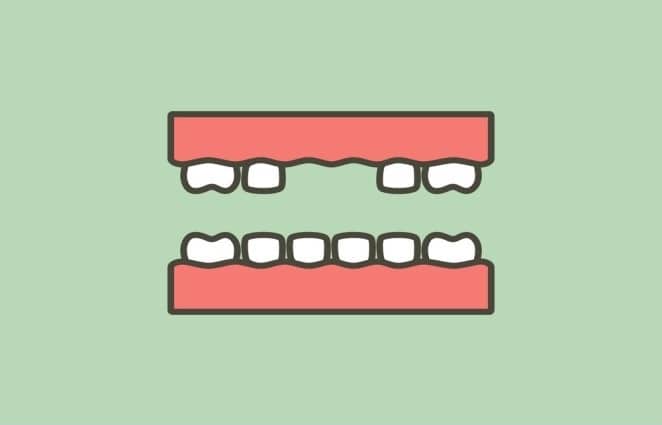
Dentists call edentulism the condition of having lost one or more teeth. Since it is irreversible and often progressive, this is one of the factors that closely mark the decline in oral health. Yet this is a condition more common than most people think.
Actually, in 2010, a survey from the National Health and Nutrition discovered that about nine million Americans live with some type of edentulism and that among persons over sixty, 25% are either partly or completely edentulous. At the Costa Rica Dental Team, more than 95 % of cases present some type of tooth loss.
Types of Edentulism: Partial vs. Total
There are two types of edentulism.
1. Partial Edentulism
Partial edentulism means the partial loss of the functional dentition. This refers to the loss of one or several, but not all, teeth. It is important to note that this definition refers only to functional teeth. The loss of wisdom teeth is not considered a form of edentulism, as they are typically not involved in regular mastication or chewing.
2. Total Edentulism
Total edentulism refers to the complete loss of functional dentition. This condition is more common among mature and senior adults and can be caused by several factors, most commonly periodontal disease, severe bruxism, or continuous bone loss.
In most cases, complete edentulism does not happen suddenly. It is usually the result of prolonged dental issues and a long-term need for comprehensive dental care.
How Edentulism Affects Oral and General Health

Living with some or most missing teeth is detrimental to overall oral health. There are studies that show that edentulism is related to chewing and nutrition problems. There is a minimum of twenty teeth necessary for proper chewing, and this only if each tooth has its antagonist.
Failure to meet this minimum results in the shifting of teeth, unbalanced distribution of chewing forces, fracture or wear on other teeth, and bone loss.
The soft tissues (gums, lips) undergo shrinkage when the edentulous areas are considerable. The presence of gaps can also be a factor in a decline in interpersonal relations and self-confidence. Edentulism is considered a real impairment in general health.
What Are the Treatment Options for Missing Teeth?
For this reason, missing teeth should be replaced at the earliest convenience. The ideal way to replace these is with dental implants, which simulate a tooth root and stop the natural process of bone resorption. Partially edentulous cases can be solved with fixed bridges, bridges over implants, individual implants, or removable partial dentures.
Completely edentulous cases can be treated with full sets of removable dentures or fixed implant-supported dentures, also known as all-on-four.
Restoring Your Smile at Costa Rica Dental Team
Edentulism is not an easy condition to live with. For this reason, our practice at the Costa Rica Dental Team offers all kinds of preventive and restorative treatments, both to prevent you from getting here and to treat those who suffer from it.
Our dentists will do their best to preserve and protect your teeth, but if complete edentulism is unavoidable, they will walk you through the process of restoration. Contact us for more information on how to replace your missing teeth.